

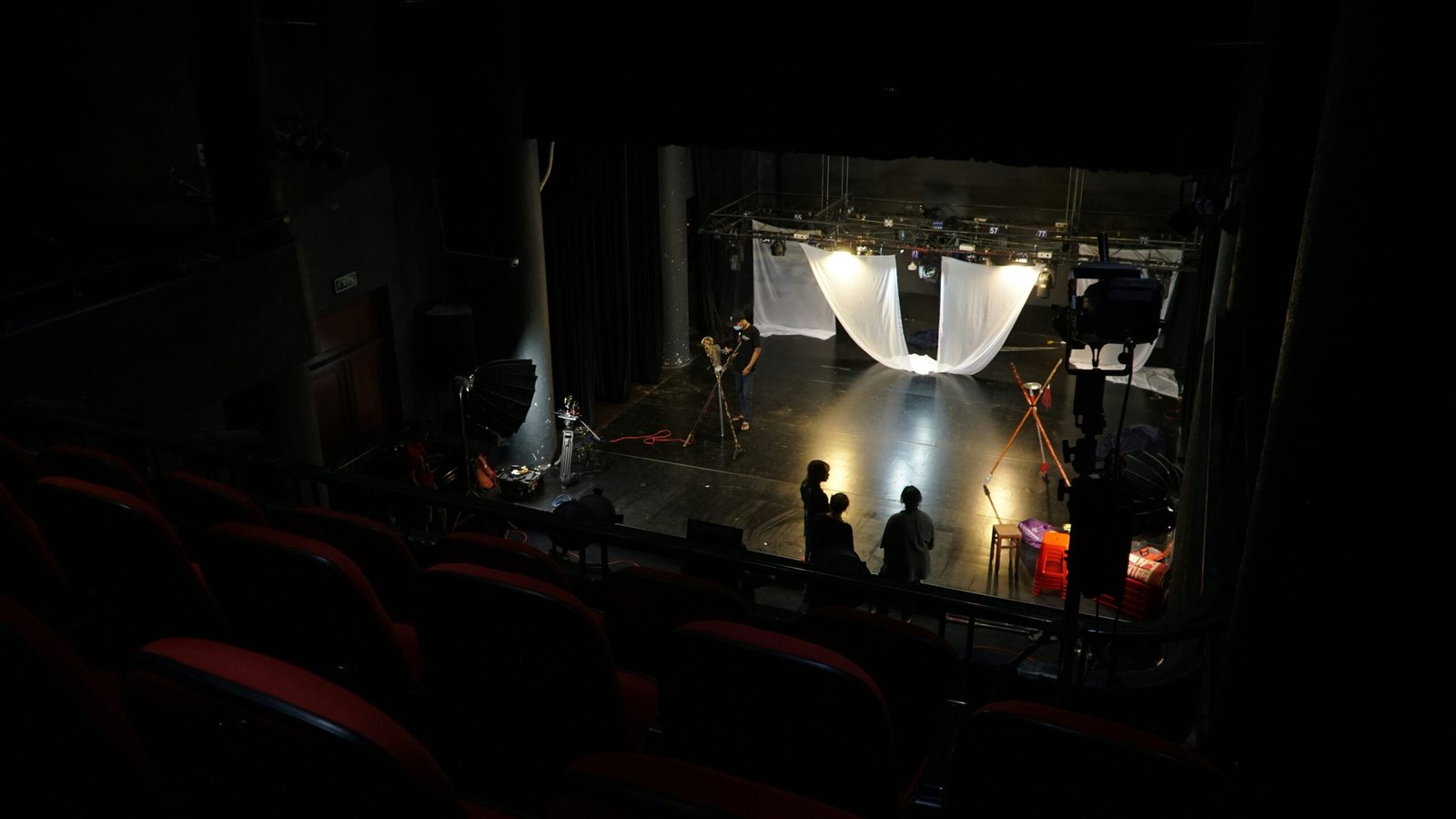
Photo by Dang Truong on Unsplash
Quick summary
- World theatre in 2026 is leaning into what screens can’t copy: live, event-style shows, star-led drama and bold new formats.
- In London, stars such as Gary Oldman, Tilda Swinton, Christine Baranski, Richard E. Grant and Rory Kinnear lead major productions, alongside experimental one-off shows. Europe’s festivals take theatre into courtyards, museums and city squares.
- Australia pairs blockbuster musicals like The Lion King with new Australian stories, including Sydney Theatre Company’s 13-play season.
- In Chennai, Theatre Marina (founded 2015; 23 productions and over 200 performances) brings the same ambition to Tamil and contemporary theatre. Its next show, Abayarangathilaga, plays on Sunday 29 November 2026 at Alliance Française of Madras.
Next on stage
Abayarangathilaga
Sunday, 29 November 2026 · 7:01 pm · Alliance Française of Madras, Nungambakkam
Live theatre across the globe is experiencing a remarkable creative renaissance. Far from being overshadowed by on-demand streaming or short-form digital entertainment, the stage has doubled down on what screens simply cannot replicate: visceral immediacy, architectural scale, daring hybrid formats, and shared human electricity. From the historic playhouses of London’s West End and continental European festivals to the booming auditoriums of Sydney and Melbourne, 2026 has proven to be a watershed year for the performing arts.
For theatre lovers and practitioners in India, watching these global currents unfold is both exhilarating and instructive—especially as homegrown collectives work tirelessly to bring that same spirit of innovation to local stages.
Europe: Star Power, Intimate Risk, and Street-Level Spectacle
Across Europe, the theatrical landscape in late 2026 is defined by a fascinating dual movement: blockbuster prestige programming inside grand venues paired with radical, boundary-blurring experimentation outdoors and in intimate studio spaces.
In London, star-driven drama and bold revivals have drawn big crowds throughout 2026. Heavyweights of stage and screen have anchored major productions this year—from Gary Oldman taking on Samuel Beckett’s Krapp’s Last Tape and Tilda Swinton starring in Man to Man at the Royal Court Theatre, to Christine Baranski and Richard E. Grant bringing razor-sharp comic timing to Noël Coward’s Hay Fever at Wyndham’s Theatre. Meanwhile, contemporary political and intellectual drama continues to command prime real estate, exemplified by Rory Kinnear portraying economist John Maynard Keynes in James Graham’s The Standard of Living at the Theatre Royal Haymarket, directed by Nicholas Hytner.
Equally notable is how London theatre is embracing franchise storytelling and high-tech stagecraft without losing theatrical soul. Productions like Stranger Things: The First Shadow at the Phoenix Theatre prove that genre-bending visual illusion can coexist alongside intimate, one-night-only experimental works such as White Rabbit Red Rabbit at the Duchess Theatre, where a different actor steps onstage each evening with a sealed, unseen script. Even the opera world is leaning into theatrical reinvention, with director Philipp Stölzl bringing a surreal new staging of Verdi’s Un Ballo in Maschera to the Royal Opera House and the English National Opera presenting Kaija Saariaho’s contemporary opera Adriana Mater at the London Coliseum.
Step across the Channel into mainland Europe, and the emphasis shifts toward interdisciplinary festivals and public-space performance. France’s autumn calendar—anchored by Paris’s Festival d’Automne running through January 2027—continues to dissolve the borders between theatre, contemporary dance, visual art, and sound installation. Across Europe, major showcases from Avignon to Sibiu and Berlin have increasingly championed site-specific works, physical theatre, and contemporary circus, inviting audiences out of conventional plush seats and into historic courtyards, museums, and city squares. The message from Europe is clear: audiences want theatre that feels like an unrepeatable event.
Australia: Homegrown Stories Meet Mega-Musical Momentum
Halfway across the world, Australia’s theatre sector is riding a wave of post-pandemic confidence, propelled by blockbuster international tours alongside a surge in proudly Australian storytelling.
In Sydney and Melbourne, major commercial houses are packed with spectacle. Disney’s The Lion King has made a triumphant return to Australian stages after more than a decade—opening in Sydney before roaring into Brisbane and Melbourne—reaffirming the enduring pull of large-scale puppetry, choreography, and live orchestral score. Alongside it, Broadway hit A Beautiful Noise: The Neil Diamond Musical has made its Australian debut, and the Tudor-pop sensation Six the Musical has returned for another sold-out national run.
Yet the real heartbeat of Australia’s 2026 season lies in its premieres of original local narratives and fresh literary adaptations. The Sydney Theatre Company’s ambitious 13-play season showcases the breadth of Australian dramatic ambition—from world premieres like Bennelong in London and Strong is the New Pretty to Whispering Jack: The John Farnham Musical, which turns one of Australia’s most beloved musical icons into full-fledged theatrical biography. Over in Melbourne, the Melbourne Theatre Company’s playful adaptation of E.M. Forster’s A Room With A View at Southbank Theatre demonstrates how classic literature can be reimagined with contemporary wit and intimacy.
Add to this Australia’s thriving cabaret, burlesque, and circus-theatre hybrid scene—seen in smash hits like Blanc de Blanc at the Sydney Opera House and The House Soirée in Melbourne—and a clear picture emerges. Australian theatre is thriving because it refuses to choose between high-art drama, sharp comedy, and pure, joyful entertainment.
Bringing the World Stage Home: Theatre Marina and Chennai’s Evolving Scene
While Europe and Australia boast centuries-old theatre infrastructure and deep institutional subsidies, the passion driving live performance in Chennai is no less electric—and few groups embody this forward-looking spirit better than Theatre Marina.
Founded in 2015 by R. Giridharan, Keerthi Mariappan, and Sri Arunkumar, Theatre Marina began not merely as a drama troupe, but as a movement to reimagine Tamil and contemporary theatre with freshness, technical rigour, and thematic audacity. Operating as a vibrant collective of about 100 members, including some 20 writers alongside directors, actors, musicians, lighting designers, and backstage specialists, the group bridges the best of two worlds: the storied discipline of classic Tamil stagecraft—drawing inspiration from legends like K. Balachander and R. S. Manohar—and the cutting-edge production sensibilities seen on international stages. Since 2015 the company has staged 23 productions and given more than 200 performances, with its 23rd production arriving in 2026.
Just as European and Australian companies are redefining genre boundaries, Theatre Marina refuses to be boxed into a single style. Its repertoire spans gripping Chola-era historical fantasy (Abayarangathilaga), high-concept science thrillers (AI Vedhalam and UnDo), literary adaptations of master storytellers like Sujatha (Netru Indru Naalai) and Girish Karnad (Anniyal), sharp social satire, and minimalist modern experiments (Never Odd or Even).
Crucially, Theatre Marina treats stage technology—particularly precision lighting design and immersive soundscapes—not as window dressing, but as a core storytelling partner. Guided by its ethos that art should “disturb the comforted and comfort the disturbed” while never forgetting to entertain, the troupe rigorously workshops every script so that narrative depth and visual spectacle reinforce one another.
In a city celebrated globally for its classical music and dance heritage, Theatre Marina is proving that Chennai’s theatre scene can stand shoulder-to-shoulder with the finest global hubs—bringing bold stories, technical excellence, and unforgettable live experiences right to the heart of Tamil audiences.
See it live this Sunday
Abayarangathilaga: An Epic from the Chozha Empire
What if a stranger from another era landed in the world of Raja Raja Chola? A historical fantasy of mysterious arrivals, royal conspiracies and secrets that could change everything.
Sunday, 29 November 2026 · 7:01 pm · Alliance Française of Madras, Nungambakkam, Chennai
Frequently Asked Questions
What is shaping world theatre in 2026?
Three currents stand out: star-led drama and bold revivals in London’s West End, interdisciplinary festivals and site-specific performance across Europe, and blockbuster musicals running alongside new Australian stories in Sydney and Melbourne. What links them is a push toward live, event-style theatre that screens cannot copy.
Who founded Theatre Marina?
Theatre Marina was founded in Chennai in 2015 by R. Giridharan, Keerthi Mariappan and Sri Arunkumar. Today it is a collective of about 100 members, including around 20 writers, plus directors, actors, musicians, designers and backstage crew. Since 2015 it has staged 23 productions and more than 200 performances.
What kind of plays does Theatre Marina stage?
Theatre Marina works across genres: Chola-era historical fantasy (Abayarangathilaga), science thrillers (AI Vedhalam, UnDo), adaptations of Sujatha (Netru Indru Naalai) and Girish Karnad (Anniyal), social satire and minimalist experiments (Never Odd or Even).
What is Theatre Marina’s next show?
The next show is Abayarangathilaga, a historical fantasy set in the reign of Raja Raja Chola. It plays on Sunday, 29 November 2026 at 7:01 pm at Alliance Française of Madras, Nungambakkam, Chennai.
How do I book tickets for Abayarangathilaga?
Tickets are available on BookMyShow. Book early, as seats at Alliance Française are limited.
Where can I see Theatre Marina’s past productions?
Visit our Productions page, or the Ten-Ally-Drama festival page for past seasons.
